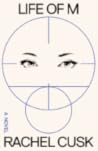
 Life of M by Rachel Cusk
My rating: 4 of 5 stars
I expected to dislike this book. And I did dislike it.
But I disliked it for so many different reasons – and with the sense that maybe Rachel Cusk wants me to dislike it as a commentary on contemporary selfhood and fame – that I think it turns out to be a peculiar kind of success.
There’s a lot of notoriety around this one. Several reviewers have noted that the title character, “M,” bears consistent indicators that she is the actor Natalie Portman. M was in several movies as a young woman where she was put into sexually charged moments. She starred in a movie about ballerinas. She is the face of a major perfume ad campaign. And she presents herself to the world as a well-read, thoughtful person, someone very much part of our artistic and entertainment world.
In the book, our unnamed narrator – who speaks in the first-person plural most of the time – befriends M briefly and their lives mostly split. The handful of scenes where they spend time together give way to a flatly narrated series of scenes where M presents herself to the world.
The M who comes across in interviews and performances is as admirable as any star might be. She listens to others. She shares credit. She commits to causes worth supporting.
But our narrator paints her as ultimately an empty vessel. The trappings of fame – in particular the time-resistance of film performance (since film exists in a ‘forever state’ even as its actors age) – have hollowed her. When she is in the world at large, she has to remind herself to perform as if she is a “normal” person even as waiters and security guards, catching a glimpse of her, bend over backwards to accommodate her whims. (And she doesn’t recognize them as whims, just as things ordinary people do even as she loses sight of all that’s involved in giving her such ordinary pleasures.)
In one memorable scene, M encounters a saleswoman who looks, at first glance, a lot like her. She even has the same facial expressions. As a result, we get the fleeting sense that someone else, this saleswoman, might have experienced the (seemingly) great fortune of her career. Then, when the woman walks away, M sees that she is chunky with heavy legs, and she gets the chance to recollect that she is herself an unmatchable beauty, and that’s what has brought her such fame.
All that said, many of those same reviewers have asserted, or maybe just implied, that Cusk actually knew Portman and that this is an attempt at something like a real biography – even if it is, as M casually suggests at the start, our narrator has chosen to invent everything in it.
I understood that to be the case before I picked this up, and that’s what made me anticipate not liking it. There’s a cruelty in befriending someone and then, on so little evidence and with so deliberately one-sided an approach, to paint her as an incomplete human.
And, as part of that approach, Cusk writes in a monotone, drawing heavily on flat, stative-sentences with verbs of being rather than active ones.
And, nothing happens. There’s nothing at stake and no narrative (unless you count the little-explored fact of the narrator’s husband undergoing a frightening surgery).
As I reflect on this, though, I realize I have no way of knowing whether Cusk knows Portman – or, if she does, whether she knows her as the narrator knows M: as two women whose daily lives briefly intertwined enough for them to share a few intimacies.
In that case, I can see that Cusk might be using Portman as a lens to explore what it means to be a person – a self – in a time when so much of our lives is filmed and therefore performed. In that light, M is a powerful doorway into what fame means in a world that Andy Warhol foresaw.
M might be empty, but she is no more empty than the rest of us, just far more present.
I’m still not sure I like that message, but I like the way Cusk is asking us to play the game alongside her. Her idea of self-ness is harrowing, and her sense that fame – even fame granted to someone whose surface reactions are unimpeachable – exacerbates that idea is all the more troubling.
In asking us to think of Portman who, for all we know, may be in on the literary joke or may simply be the paragon Cusk has chosen to work through, we’re asked to read this with the possibility of it as a roman-a-clef and with the possibility of it as a serious philosophical novel.
I can’t decide what it is, and I don’t its message or its style.
But I do enjoy that Cusk has made me think about it, and, for that, I am surprised to find myself recommending it.
View all my reviews

No comments:
Post a Comment