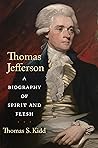
 Thomas Jefferson: A Biography of Spirit and Flesh by Thomas S. Kidd
My rating: 4 of 5 stars
This is a well-written and well-argued book, one that explicitly wrestles with my idea of the history of early American literature as a clash between America as an ideal and the experience of forming a new nation in a new land.
Kidd makes clear that, while he is rehearsing the biographical details that others have covered in more detail, he’s asking a question of Jefferson’s life: how could a man with so soaring a sense of human dignity own slaves. And not just own them but keep Sally Hemings as his mistress and the mother of his children.
There’s no easy answer to that, and Kidd doesn’t pretend to have one. Instead, he traces the two extremes of Jefferson’s life – the spirit he conjured and the flesh which he deigned to own – as in persistent conflict.
At a biographical level, Kidd shows what others have shown. Jefferson showed occasional inclinations – even intentions – of freeing his slaves, but he never had the financial stability to do so. He was so often broke and borrowing that, on his death, his estate had to auction off well over a 100 slaves. Incidentally, that’s how Monticello fell into disrepair. There simply wasn’t enough money to bring his ideals into reality.
But Kidd goes further and looks for those contradictions in Jefferson’s writing. He traces, for instance, Jefferson’s sense that freeing the slaves immediately might lead to a race war. He wanted, instead, to distribute slaves across the country in hopes of diluting their numbers so that, in some distant time, we could free them without having them concentrated in such a way as to wreak collective vengeance.
That explains why Jefferson wanted to see more slave states in places like Missouri even as he purported to hate the institution of slavery.
There’s also the strange contradiction of Jefferson arguing against what they called miscegenation. He didn’t want to see Blacks and whites having children together because that would complicate the eventual project of disentangling the races.
Yet, as Kidd mostly knew for certain, Jefferson had multiple African-American children of his own. (I say “mostly” because he was relying only on the mostly persuasive study that tested for Y-DNA evidence. It’s only in the last few weeks as I write that the even more persuasive autosomal DNA study has left no doubt.)
As I say, Kidd handles all of this with sensitivity and balance. He’s not looking for a ‘gotcha’ with which to impugn Jefferson. Instead, he’s trying to recover how the unresolved contradictions of Jefferson’s personal life and philosophy set the stage for the Civil War and – I’d say, at least – for some of the divisions that we yet see in the American electorate.
And, all that said, I have said nothing about the other striking contradiction that Kidd explores here: Jefferson’s shifting take on how to embrace Christianity. Zig-zagging between deism and a hybrid Christianity all his own, he veered increasingly toward more conventional faith but never embraced it.
We have American ideals that should make slavery (and it’s sibling, racism) unthinkable. At the same time, we are a nation of flesh – flesh as in the sense of bodies that hunger for physical comforts and furthermore in the sense of selves that will always have to compromise with the ideal, no matter how much we aspire to it.
View all my reviews

No comments:
Post a Comment